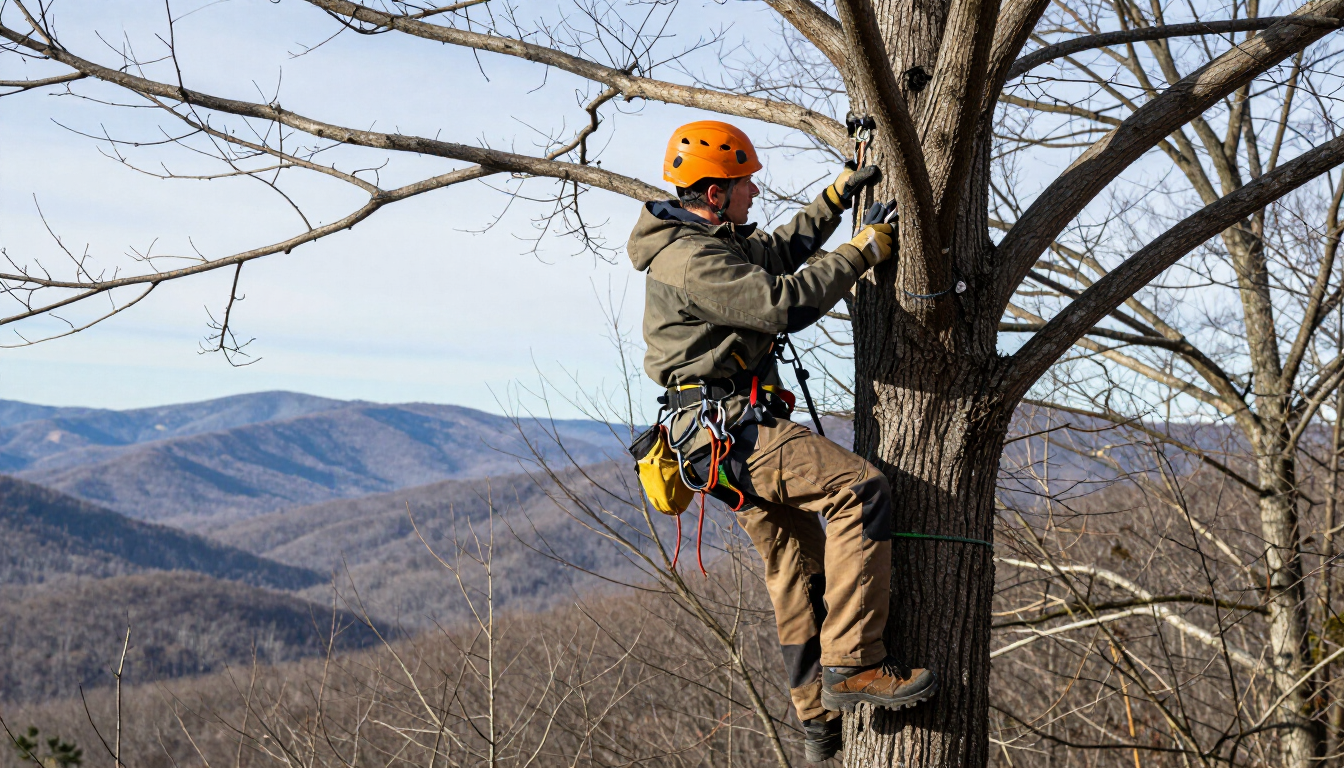
Dynamic cabling is one expression of that philosophy. It's one of the
tree cabling and bracing services we offer throughout Asheville and Western North Carolina.
When a mature tree develops a vulnerable union, co-dominant stems or a heavily leveraged limb, we have choices. Sometimes removal is necessary. Sometimes pruning can sufficiently reduce the risk. Sometimes traditional static support is appropriate. But sometimes the best intervention is simply to give the tree a little additional support without asking it to stop being a tree. That is the purpose of dynamic cabling.
Trees Are Built to Move
A tree is not a building. Buildings are generally engineered to resist movement. Trees have evolved to move.
Wind bends trunks and branches throughout a tree's life. That movement isn't merely something a tree survives. It is information. Trees perceive mechanical loading and respond to it biologically through a process researchers call thigmomorphogenesis — mechanical movement can influence stem taper, radial growth, wood formation, branch reinforcement and other aspects of tree architecture.
A tree develops in relationship with the forces acting upon it. This matters when we decide how to support a structurally vulnerable tree: whenever possible, we don't want our intervention to replace the structural work the tree is capable of doing for itself. We want to help at the margins — reducing movements that may exceed the capacity of a vulnerable union while preserving the ordinary movement through which the tree continues responding and adapting. That is the fundamental idea behind dynamic crown support.
The cable supplements the tree. It does not attempt to become the tree's structure.
Dynamic and Static Cabling: Different Relationships With the Tree
Dynamic and static cabling are both legitimate tools in professional arboriculture. They simply establish different mechanical relationships with the tree.
Static Cabling
Traditional static systems generally use high-strength steel cable attached to hardware installed into the stems. Their purpose is restraint. By substantially limiting movement between two parts of a tree, static systems can provide important support where a union is cracked, separating or otherwise requires significant restriction. There are trees for which this is exactly the appropriate intervention. But static support also changes the mechanical environment in which those stems are growing, and installation generally requires drilling into living wood. For those reasons, we don't automatically choose greater rigidity simply because greater rigidity is possible.
Dynamic Cabling
Dynamic cabling takes a different approach. Rather than attempting to eliminate movement, a dynamic support system allows considerable normal crown movement while limiting excessive separation during unusually high loading events such as wind, snow or ice. It can also be installed without drilling into the tree.
The distinction is important: static support asks, "How can we hold this structure in place?" Dynamic support asks, "How much help does this tree actually need?" Neither question is universally right or wrong. Relational Tree Care means choosing the intervention appropriate to the particular tree.
If you'd like a closer look at how we evaluate a tree's structure before recommending any system, our
tree cabling and bracing guide walks through five signs a mature tree may need support.
Dynamic Cabling Is Not Experimental
Synthetic dynamic crown-support systems have been used in professional arboriculture for decades, and are particularly well established in European arboriculture. Germany's ZTV-Baumpflege tree-care standards distinguish between dynamic and static crown-support systems and provide guidance regarding their appropriate application, placement and strength.
One of the best-known European dynamic systems, Cobra, has been in use since the early 1990s. Its manufacturer reports more than 500,000 crown-support systems installed worldwide, and some of its systems installed according to European standards carry specified service lives of up to 12 years.
Here in the United States, supplemental support systems are addressed through the ANSI A300 Tree Care Standards, and professional guidance recognizes both static and dynamic approaches. Tree Care Industry Association educational materials describe dynamic systems as principally proactive systems intended to reduce excessive extension during unusual loading while retaining considerable freedom of natural movement.
The System Follows the Tree
At Arborsmiths Asheville, we don't believe in choosing a product first and then applying it to every tree. We assess the tree first. Then we choose the system.
We are experienced with multiple professional dynamic crown-support systems, including Notch Dryad, Cobra and other purpose-designed synthetic systems. For many installations, we use Notch Dryad, a high-strength, 24-strand hollow-braid polyester crown-support line — it can be installed without drilling into the tree, is UV- and abrasion-resistant, and is available in multiple diameters with published average tensile strengths ranging from approximately 3,000 to more than 10,000 pounds.
Cobra, developed in Germany and used internationally since the early 1990s, offers another approach: its components are designed to provide controlled elasticity and can be configured at different load capacities according to the structural requirements of the tree.
The product doesn't determine the treatment. The tree does. We consider the species, age, architecture, condition of the union, anticipated loads, degree of movement we want to preserve, surrounding targets and the long-term management objectives for the tree before specifying a support system.
Why Non-Invasive Matters
Trees don't heal wounds in the same way that people do. They respond by compartmentalizing damaged tissue and growing around it. The original wound remains inside the tree.
Traditional static cabling may require drilling through living wood to install its anchors, and sometimes the structural benefit justifies that intervention. But Relational Tree Care asks another question: if we can accomplish the objective without creating a wound, why create one unnecessarily? This becomes particularly important when working with mature trees, trees with existing decay or species that are relatively poor compartmentalizers. Dynamic systems give us the ability to support many trees without drilling into them at all.
The Limitations of Dynamic Cabling
Relational Tree Care doesn't mean always choosing the least invasive intervention. It means choosing the least intervention capable of responsibly accomplishing the objective.
Sometimes dynamic cabling isn't enough. A cracked or actively separating union may require static support. Another tree may require reduction pruning. A severely compromised tree may no longer be an appropriate candidate for preservation.
And no cabling system makes a tree completely safe. Trees are living structures — risk can be managed, but it cannot be eliminated. That is why proper assessment comes before choosing the system.
A Cable Is Not the End of the Relationship
Perhaps the biggest difference between our philosophy and a purely mechanical approach to tree care is what happens after the cable is installed. We don't think: problem, cable, fixed. Because the tree isn't finished — it keeps growing, its stems increase in diameter, its crown changes, the union changes, the material ages, storms occur.
Installing a support system creates an ongoing stewardship responsibility. Supplemental support systems should be periodically revisited by a qualified arborist. During those inspections we evaluate the cable itself, but we are really evaluating something larger: the evolving relationship between the cable and the tree — its condition and position, changes in stem diameter, attachment points, abrasion or degradation, the condition of the supported union, developing decay, and whether pruning, adjustment, replacement or a different strategy has become appropriate. We also recommend reassessment following significant storm events or whenever a client notices an important change in the tree.
This Is Relational Tree Care
Modern tree care has inherited a lot of language from engineering and property management — defects, loads, targets, assets, mitigation. All of those concepts have value, but they can also obscure something fundamental: the thing we're caring for is alive.
A mature tree is not a defective structure waiting for us to engineer it into permanence. It is an organism continuously negotiating gravity, wind, weather, soil, fungi, insects, wounds, competition, growth, decay and time. Sometimes our job is to understand what the tree is already doing, determine where it needs help, and intervene thoughtfully enough that the tree can continue doing the rest.
We don't simply install a cable. We begin a relationship that periodically needs tending. That is Relational Tree Care.
Research & Professional Resources
For clients interested in learning more, our approach is informed by current arboricultural standards, tree-biomechanics research and decades of international experience with dynamic crown-support systems.
ANSI A300 Tree Care Standards — Supplemental Support Systems. U.S. professional standards addressing cabling, bracing and supplemental tree support.
Tree Care Industry Association — Supplemental Tree-Support Systems. Professional guidance describing static and dynamic systems and their appropriate applications, including Notch Dryad.
Research on Thigmomorphogenesis and Tree Biomechanics. Peer-reviewed research examining how trees perceive and adapt their growth to mechanical movement and wind loading.
ZTV-Baumpflege / European Crown-Support Standards. German professional tree-care guidance covering dynamic and static crown-support systems.
Notch / Sterling Dryad Dynamic Cabling. Technical specifications for the non-invasive dynamic crown-support material used by Arborsmiths Asheville.
Have a Tree That Might Need Support?
If you have a mature tree on your property with a vulnerable union, co-dominant stems, or a heavily leveraged limb, we'd be glad to take a look. Arborsmiths Asheville handles
tree cabling and
bracing services across Asheville and Western North Carolina. Call us at (828) 519-5577 or reach out through our
contact page for a free quote.